Canadians, communities and workplaces benefit when everyone can participate equally in everyday life. In 2019 the Government of Canada passed new accessibility legislation, the Accessible Canada Act, to promote equality of opportunity and increase the inclusion and participation of Canadians who have disabilities or functional limitations. Many Indigenous and non-Indigenous Canadians continue to face barriers that affect their ability to participate fully in their communities. Through a funding agreement with Employment and Social Development Canada (ESDC) IDC is undertaking a research project that engages Indigenous communities, Indigenous individuals, and families living with disabilities, service providers and provincial and federal governments in relation to the new Federal Accessibility Legislation for their input, expertise and direction to how it can be modified to meet the unique and diverse accessibility needs of Indigenous persons living with disabilities.

First Nations Accessibility Standards:
A Path Forward To Inclusion
What is the Accessible Canada Act?
The Accessible Canada Act (ACA) came into force in 2019. The overarching goal of the ACA is to realize a barrier-free Canada by 2040. The legislation benefits all Canadians, especially persons with disabilities, through the proactive identification, removal and prevention of barriers to accessibility in 7 priority areas:
-
employment
-
the built environment
-
information and communication technologies (ICT)
-
communication other than ICT
-
the design and delivery of programs and services
-
the procurement of goods, services and facilities
-
transportation
The ACA applies to a wide range of federally regulated entities. This includes, for example:
-
industry sectors such as banking, telecommunications and transportation
-
Government of Canada departments and agencies
-
Parliament
-
Crown corporations
-
Canadian Armed Forces
-
Royal Canadian Mounted Police, and
-
First Nations band councils
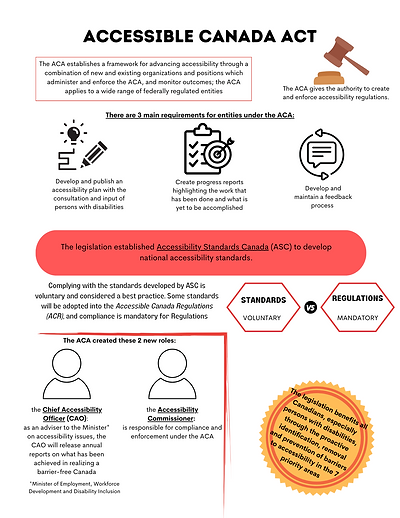
The ACA requires regulated entities to prepare and publish accessibility plans, set up feedback processes and report openly on progress. The ACA gives the authority to create and enforce accessibility regulations.
The ACA establishes a framework for advancing accessibility through a combination of new and existing organizations and positions which administer and enforce the ACA, and monitor outcomes.
The legislation established Accessibility Standards Canada (ASC) to develop national accessibility standards. ASC has established several technical committees that are actively developing standards that remove barriers in several different priority areas. Compliance with standards developed by ASC is voluntary unless they are adopted into regulations.
The ACA also created 2 new roles:
-
the Chief Accessibility Officer (CAO): as an adviser to the Minister on accessibility issues, the CAO will release annual reports on what has been achieved in realizing a barrier-free Canada, and
-
the Accessibility Commissioner: responsible for compliance and enforcement under the ACA